
4 Color Problems Ruining Your Coloring
(And How to Fix Them)

INTRODUCTION
Have you ever stared at your colored pencil collection, completely overwhelmed by which colors to use? Or finished a page only to realize it looks flat and boring? Maybe you’ve tried blending colors that should work together but ended up with muddy brown instead?
I get it. I’ve been there too.
When I first started coloring, I’d spend 15 minutes just choosing colors—then second-guess every choice I made. My finished pages either looked washed out or had colors that clashed. I had 72 beautiful colored pencils but only used the same 10 safe colors over and over because I was terrified of making mistakes.
Then I discovered something that changed everything: the color wheel.
You’ve probably seen it before—a circle showing how colors relate to each other. It looks complicated at first, but here’s the truth: there are only three simple patterns you need to know. Once you see these patterns, choosing colors becomes automatic instead of stressful.
In this guide, you’ll learn:
- The one tool that solves all your color choice problems (and you probably already own it)
- Why some color combinations look muddy (and the simple fix)
- How to instantly know which colors work together (no guessing required)
- The secret to making flat coloring look three-dimensional
- A simple system for organizing your supplies so you always grab the right pencil
Here’s the best part: You don’t need to memorize color theory or learn complicated rules. I’ll show you three visual patterns that make sense the moment you see them. By the end of this tutorial, you’ll look at your colored pencil collection and see possibilities instead of confusion.
Ready to stop second-guessing your color choices? Let’s start with the tool that changes everything: the color wheel. You’re about to see why it’s simpler than you think.
QUICK PROBLEM DIAGNOSIS
Start here:
- Identify which symptoms match your coloring problem
- Click through to that solution
- Apply the fix to your next coloring page
- See immediate improvement
Problem 1 (Muddy Colors)
- My finished pages look muddy or dull
- Colors that looked good separately look “off” together
- My coloring lacks vibrancy and “pop”
- Everything blends together instead of standing out
→ You have: Muddy Colors Problem. Jump to Solution
Problem 2 (Color Overwhelm)
- I spend 10+ minutes just staring at my colored pencils
- I can’t decide which colors to use together
- My 150-color set overwhelms me
- I always end up using the same few safe colors
→ You have: Color Overwhelm Problem | Jump to Solution
Problem 3 (Flat Coloring)
- My coloring looks flat and cartoon-like
- I can’t create realistic shadows
- Everything looks the same brightness
- My pages lack depth and dimension
→ You have: Flat Coloring Problem | Jump to Solution
Problem 4 (Organising Chaos)
- The pencil color doesn’t match what appears on paper
- I can’t find the color I want when I need it
- I own multiple brands and can’t coordinate them
- I have no system for organizing my supplies
→ You have: Supply Chaos Problem | Jump to Solution
Have multiple symptoms? Start with Problem 1 (Muddy Colors)—it’s the quickest win and often improves the others automatically.
YOUR COLOR PROBLEM SOLVER
The Color Wheel: Your Visual Guide to Better Color Choices
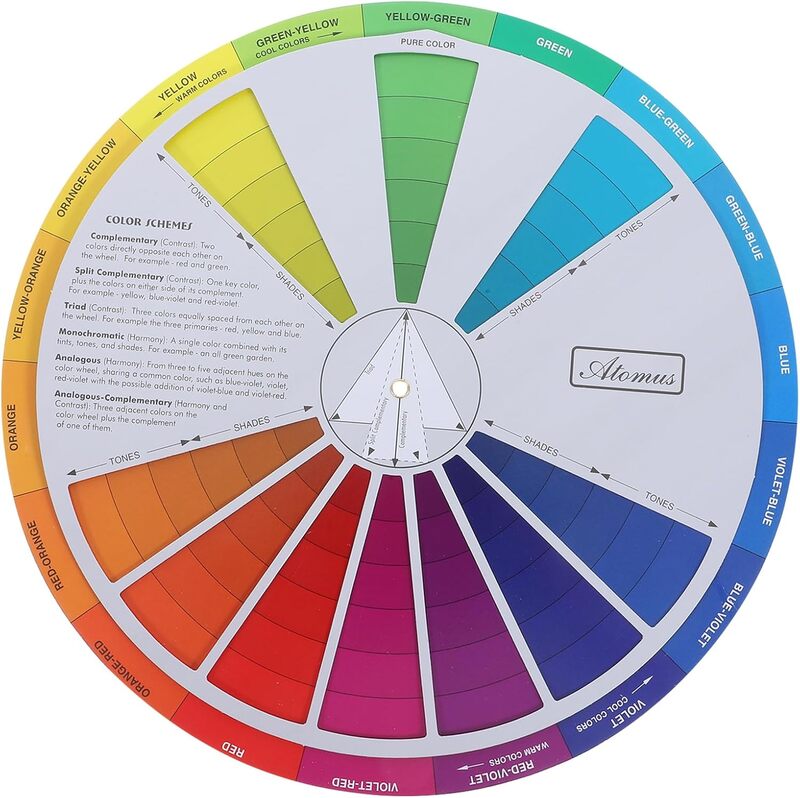
If you click on this color wheel picture it will pop open into a larger size. If you then right click you can open that image in a new tab or window. That way you can just click backwards and forwards between the color wheel image and the text explanation below.
This is a basic color wheel. We will use it to explain how the color wheel works and then how it can solve your problems.
How the Color Wheel Works
The color wheel was invented in the late 1600’s by Isaac Newton to map the color rainbow spectrum onto a circle. Since then the color wheel advanced into multiple versions and become the basis of color theory showing the relationship between colors.
Let’s concentrate on just a basic understanding as it will solve most of your problems right away.
Here’s how the color wheel works to form patterns. Check against the color wheel image above as you read the following so you can see how it works.
Primary Colors (RYB) are Red, Yellow, and Blue.
Secondary Colors result from mixing two primary colors. Violet or Purple results from red and blue, Orange from red and yellow, and Green from yellow and blue.
Tertiary Colors are made from a secondary color and a primary color. For example, Red (primary) and Orange (secondary) create the color called Red-Orange.
Complementary Colors are on opposite sides of the color wheel and provide a high contrast and high impact color combination. So yellow and violet are complementary and contrast against each other to make a picture brighter. See the contrast between the violet clouds and yellow sunset in the image at the very top of this page.
Monochromatic Colors are variations of the one color and are created by mixing in black and white or grey. These variations are called tones and shades. They are used to create calm and a peaceful atmosphere in a picture. There is not that contrast of colors found with complementary colors. For example, a garden or forest would comprise various tones and shades of just green just like in real life.
Analogous Colors are used to create a mood or emotion in a picture generally found in nature. They are selected from colors that are next to or very close to each other (neighbouring) on the color wheel. For example, orange-red, red-orange, and orange could be used to create sunsets or autumn leaves.
Warm and Cool Colors are on either half of the color wheel. Warm colors range from yellow to red-violet and cool colors from violet to green-yellow. You would use warm colors to create feelings of being warm and cosy. Cool colors would suggest calmness and large open spaces. There is a whole field of study called Color Psychology investigating how colors affect our feelings.
So, I hope you understood how important a color wheel can be in selecting the right colors for your pictures.
In the next section, I’ll show you exactly how to use each pattern tto help solve your color problems.
How to Apply the Color Wheel to Fix Your Problems
For Problem 1 (Muddy Colors)
Use Complementary Colors.
What this pattern does: Those opposite colors make each other look more vibrant and alive. They create excitement and energy. They complement each other.
How this fixes the muddy colors problem: When you use opposites strategically, your colors stay bright instead of turning muddy.
Where you’ll learn more: For a detailed understanding and step by step on how to make a subject pop, or show subtle accent details or other tips see Fix Muddy Coloring.
- For Problem 2: Which colors sit next to each other (analogous) for easy limited palettes
- For Problem 3: How to identify light, medium, and dark values
- For Problem 4: How to organize your supplies by color relationships
I resisted buying a color wheel for months. “I“can just remember which colors work together,” ” thought. When I finally got one, I realized I’d’been wasting HOURS guessing—and getting it wrong.
What I love about physical color wheels:
- Instant answers (no googling, no guessing)
- Shows all four problem solutions at a glance
- Sits on your desk while you color
- Costs under $15 and lasts forever
Here’s how the wheel works:
The color wheel shows you how colors relate to each other by arranging them in a circle. The colors that are close together have relationships, and the colors that are far apart have relationships too. Once you understand these relationships, choosing colors becomes easy.
The Three Patterns That Fix Your Problems
Now that you can see the wheel, let me show you the three patterns. I promise—they’re obvious once you see them.
PATTERN 1: Colors Across From Each Other
Look at the wheel. See how some colors sit directly opposite each other? Like blue across from orange, or red across from green?
What this pattern does: These opposite colors make each other look more vibrant and alive. They create excitement and energy. They complement each other.
Which problem this fixes: Problem 1 (Muddy Colors). When you use opposites strategically, your colors stay bright instead of turning muddy.
Where you’ll learn more: Section 5 shows you exactly how to use this pattern in your coloring.
PATTERN 2: Colors Next to Each Other
Now look at colors that are neighbors on the wheel—sitting right next to each other. Like blue, blue-green, and green. Or red, red-orange, and orange.
What this pattern does: Neighboring colors always look harmonious together. They create calm, pleasing combinations that just work—no guessing required.
Which problem this fixes: Problem 2 (Color Overwhelm). When you choose neighbors, you literally can’t make a bad color choice.
Where you’ll learn more: Section 6 walks you through using this pattern step-by-step.
PATTERN 3: Light and Dark Versions
This pattern isn’t about different colors—it’s about different shades of the same color. Think light blue, medium blue, dark blue. (On some color wheels, you’ll see this shown as rings moving from the center outward, or you’ll imagine it as adding white or black to a color.)
What this pattern does: Using multiple shades of the same color creates depth and dimension. It’s what makes coloring look professional instead of flat.
Which problem this fixes: Problem 3 (Flat Coloring). Lights and darks make your coloring look three-dimensional.
Where you’ll learn more: Section 7 shows you the simple technique for adding dimension.
The Bonus: Fixing Problem 4 (Organising Chaos)
Here’s something cool that happens once you understand these three patterns: organizing your colored pencils becomes obvious.
Instead of having a jumbled pile of random colors, you’ll naturally group them by:
- Where they sit on the wheel (neighbors together)
- Their opposites (kept nearby for vibrant combinations)
- Light to dark shades (arranged in order)
Suddenly, when you need “a color that goes with this blue,” you’ll know exactly where to look—either at blue’s neighbors or across to its opposite. No more digging through your entire collection hoping to find the right pencil.
ADVANCED TOOLS
The above information is all most beginners need. Honestly, these three patterns will transform your coloring.
But as you practice, experiment, and gain confidence, you might want to go deeper. Maybe the basic solutions work great, but you’re curious about doing more. Or maybe you have a specific challenge that needs a specialized approach.
That’s where the advanced tools come in. Think of them as optional upgrades—there when you need them, but not required to get started.
Planning Tools
Some colorists like to plan their color choices before they start. If that sounds helpful:
- Color palette selection – Pick your 3-5 colors ahead of time (reduces decision stress)
- Color prompts – Fun challenges like “use only 3 colors”. Some FaceBook Coloring sites provide regular challenges like this to help expand your skills.
→ Available in the Pre-Planning Tools section
Organization Tools
If you have 50+ colored pencils and struggle to find the right one:
- Color charts – Make swatches showing your true colors. They can be provided by the manufacturer like Prismacolor or maybe you need to create your own color chart from a recent purchase.
- Color cubes – A 3D organization system for large collections (advanced organizers love this)
- Storage systems – Physical storage ideas to keep supplies accessible
→ Available in the Organization & Tracking section
Technique Tools
Once you’ve mastered the basics and want to add more dimension:
- Advanced blending – Different methods for ultra-smooth color transitions
- Professional shading – Where to place shadows for realistic depth
- Layering techniques – Building rich, deep colors through multiple layers
→ Available in the Application Techniques section
Here’s my advice: Don’t try to learn everything at once. Start with the color wheel basics below. Use that knowledge for a few coloring sessions. See what works and what still feels challenging.
Then come back and explore just the one tool that addresses your remaining challenge.
You’re building skills, not cramming for an exam. Take it at your pace.